
Demystifying AI Search: 4 Visibility Myths You Need to Ignore
July 8th 2026 by Click Here Digital
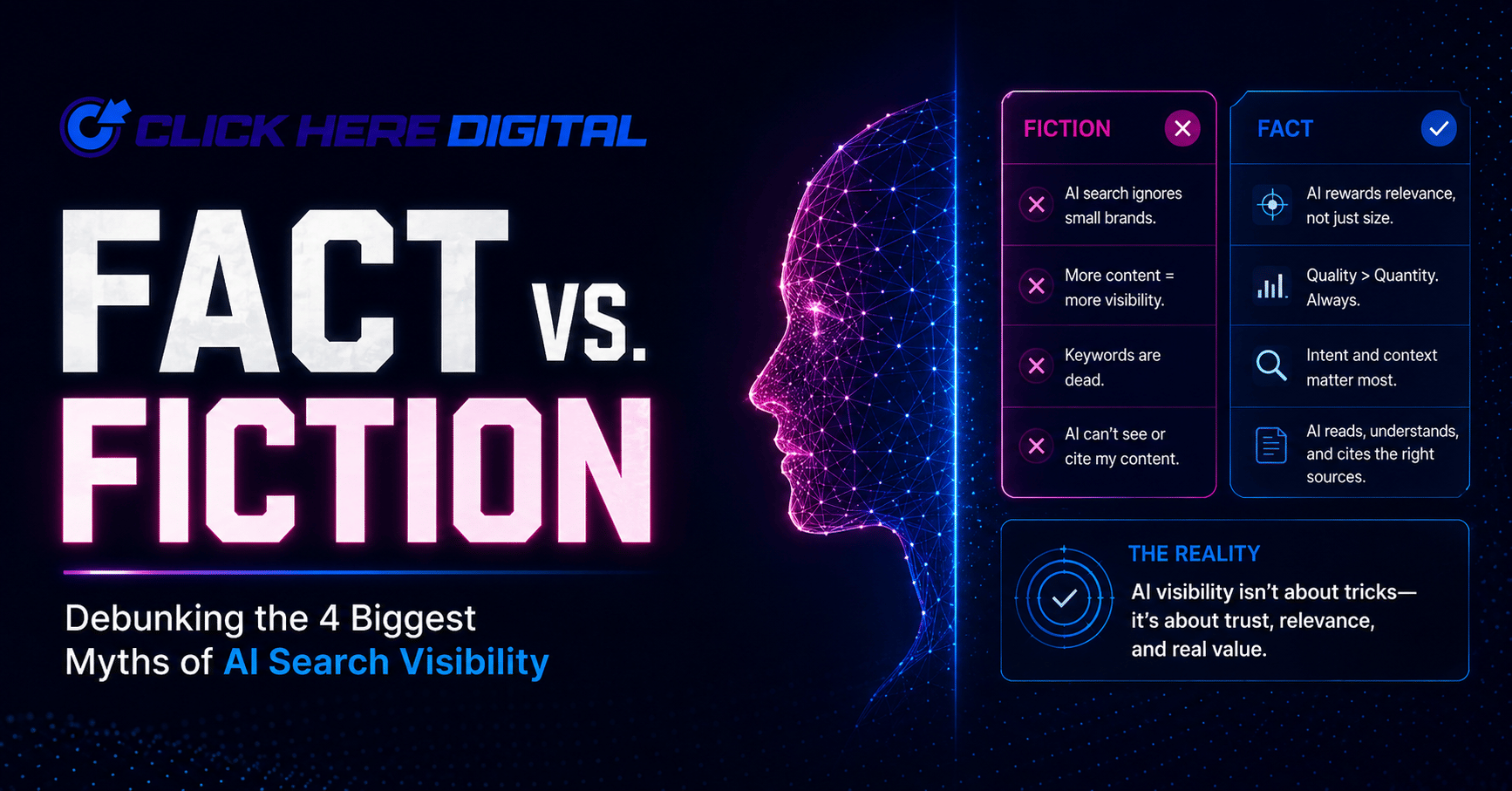
If you’ve spent any time exploring digital marketing recently, you’ve probably noticed buzzwords like "GEO" (Generative Engine Optimization) or "AI Search Visibility." As platforms like Google AI Overviews, ChatGPT Search, and Perplexity continue to reshape how users research and discover information, there is no shortage of “experts” advising how businesses can show up in AI-generated results.
With so many diverse and opposing opinions on the matter, it can be difficult to separate emerging best practices from sheer speculation. The truth is that AI Search is still evolving, and many commonly repeated advice or recommendations haven’t been thoroughly tested and validated.
At Click Here Digital, we don't guess or speculate. Our approach is rooted in research and real-time observation. We actively analyze how large language models (LLMs) interact with and reference web content to better understand what influences AI visibility.
Let’s look past the marketing hype and break down the engineering reality behind four major AI visibility questions.
1. Does AI search mean traditional SEO is dead?
The Myth: AI search engines magically synthesize information from scratch, meaning the foundational elements of standard search engine optimization no longer matter.
The Engineering Reality: AI engines are aggregators; they rely entirely on a crawlable index of the web to learn what is accurate, trusted, and locally relevant. If a website has broken paths, slow loading speeds, poor structure, or unoptimized map profiles, an AI crawler will discard it.
The Pivot: Core SEO principles have actually become the prerequisite for AI visibility. Ensuring a flawless, healthy foundational footprint across the web is the only way to feed AI engines the pristine data they require to find and trust your business.
2. For your website to be visible to AI, do you need an llms.txt file?
The Myth: Adding an llms.txt file to your website's root directory is an "SEO hack" that will suddenly cause your business to rank higher and get cited more often in Google AI Overviews or ChatGPT Search.
The Engineering Reality: It completely fails as an optimization play for visibility. AI search crawlers (like OAI-SearchBot or Google-Extended) overwhelmingly ignore llms.txt and crawl standard HTML directly. Google’s Search team has explicitly noted that llms.txt is not a search discovery lever and plays no role in AI Overview rankings.
The Pivot: While it won't help your business look better in search results, llms.txt is an incredibly important infrastructure tool for Agentic Experiences. When autonomous AI browser agents land on a site to execute a task (like booking an appointment or running an automated system check), they look for llms.txt as a fast, markdown-mapped roadmap so they don't waste computing power. We deploy these files to future-proof our clients' sites for the next generation of autonomous AI task-agents.
3. Is Schema markup highly effective for AI visibility?
The Myth: Bolting endless amounts of Schema markup onto your site will automatically guarantee top AI citations, acting as a shortcut even if your actual content is thin or lacks authority.
The Engineering Reality: Comprehensive schema coverage alone does not correlate to higher citation rates in purely generative LLMs, which prioritize raw topical relevance first. Furthermore, if information is hidden in your back-end code but doesn't actually appear as visible text on the page, AI engines will discard it entirely.
The Pivot: Schema is an essential translator, not a shortcut. Major search engines explicitly use structured data in their retrieval pipelines to map out "Knowledge Graphs." By organizing explicit entities (like a specific vehicle's details or local legal practice areas), it reduces machine ambiguity. We build advanced schema architectures to ensure that when an AI engine is looking for a verified, trusted local data point to quote, it chooses our client.
4. Do zero-click searches mean organic visibility no longer drives real revenue or local leads?
The Myth: Because AI Overviews answer user questions directly on the search results page, organic digital presence is dying and no longer brings in high-value customers.
The Engineering Reality: Informational "top-of-funnel" clicks may decrease, but the traffic that does click through from an AI Overview possesses incredibly high buying intent. For local businesses like car dealerships or law firms, AI engines rely heavily on real-world market signals like proximity, up-to-date attributes, and authentic client reviews to recommend answers.
The Pivot: We stopped chasing empty traffic metrics and pivoted to optimizing for conversion, wherever it happens. We are actively running targeted Brand Authority Boosts to properly catalog and showcase our clients' real-world community involvement, reviews, and physical presence online. We feed AI engines the exact local proof points they need to confidently recommend our clients' showrooms and offices.
The Bottom Line: Winning the future of search isn't about chasing shortcuts or panic-pivoting every time a new AI tool launches. It’s about building a clean digital presence, structuring your data perfectly so machines can read it, and proving your real-world local authority.
Curious how your business currently looks to AI search engines?

Contact us today and watch your business grow.
Ready to take your marketing strategy to a new level?
We'd love to hear from you.