
The FTC CARS Rule in 2026: What Auto Dealers Need to Know Before the Next Warning Letter
May 18th 2026 by Click Here Digital
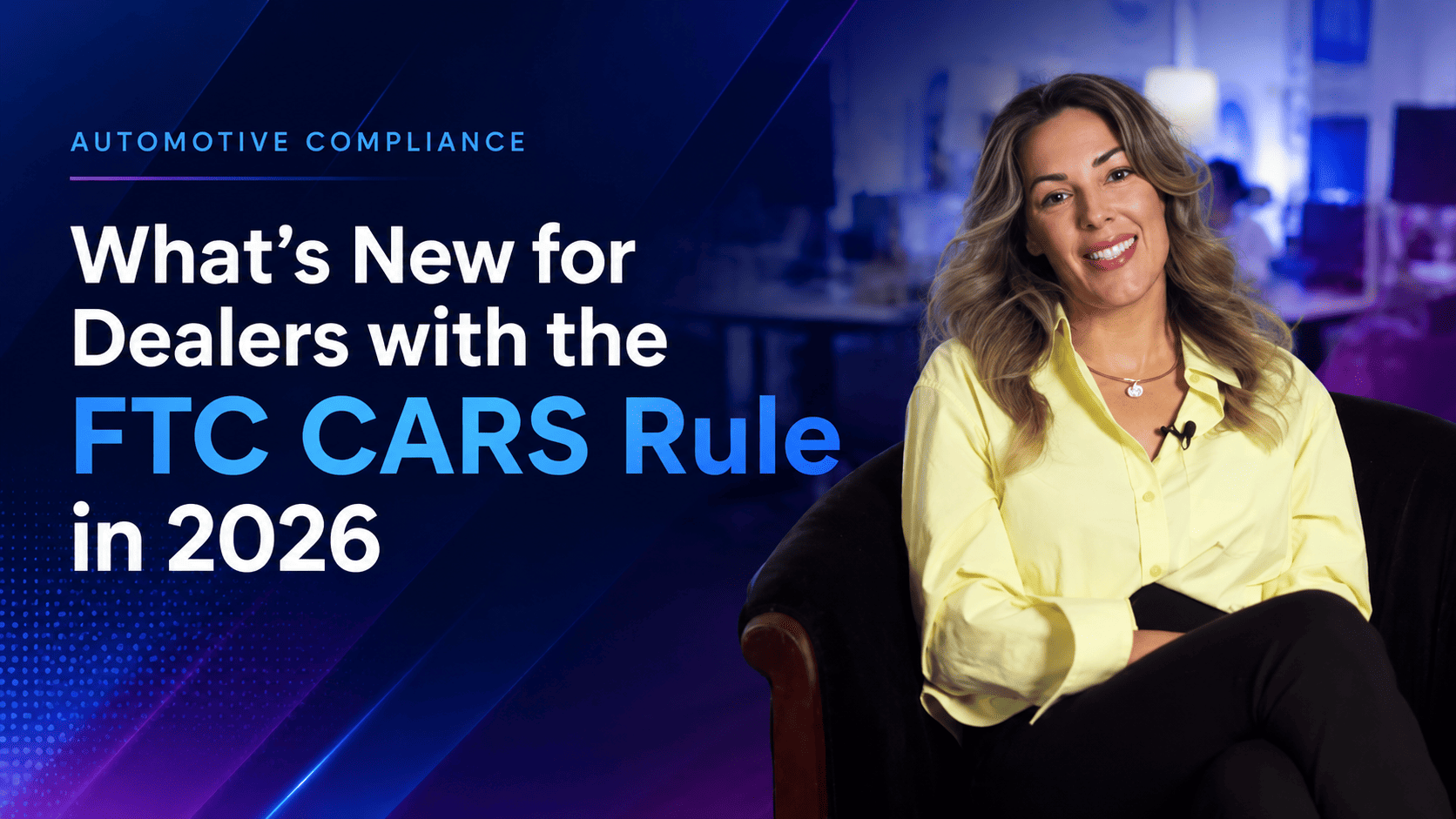
Earlier this year, the Federal Trade Commission sent more than 90 warning letters to auto dealers across the country. Several dealer groups received penalties for charging consumers for add-ons they didn't agree to or that were misrepresented at the point of sale.
The clearest takeaway: regulators are sharpening scrutiny around how dealerships advertise — particularly online.
That scrutiny is being driven by the FTC's Combating Auto Retail Scams (CARS) Rule, designed to address deceptive practices like bait-and-switch pricing, hidden fees, and misleading offers. The rules themselves are not new. The enforcement environment has changed.
This guide walks through what the CARS Rule requires, where compliance gaps usually appear, how dealerships can self-audit, and where a marketing partner fits — and doesn't fit — into that process.
Earlier this year, the Federal Trade Commission sent more than 90 warning letters to auto dealers across the country. Several dealer groups received penalties for charging consumers for add-ons they didn't agree to or that were misrepresented at the point of sale.
The clearest takeaway: regulators are sharpening scrutiny around how dealerships advertise — particularly online.
That scrutiny is being driven by the FTC's Combating Auto Retail Scams (CARS) Rule, designed to address deceptive practices like bait-and-switch pricing, hidden fees, and misleading offers. The rules themselves are not new. The enforcement environment has changed.
This guide walks through what the CARS Rule requires, where compliance gaps usually appear, how dealerships can self-audit, and where a marketing partner fits — and doesn't fit — into that process.
What the FTC CARS Rule Actually Is
The Combating Auto Retail Scams (CARS) Rule was finalized in 2024 as a dealership-specific application of the FTC's authority under Section 5 of the FTC Act, which prohibits unfair or deceptive acts and practices.
The Rule focuses on four principles:
- All-in pricing — the advertised price must include all mandatory dealer fees.
- Restrictions on deceptive add-ons — optional products cannot be presented as required.
- Express informed consent — consumers must affirmatively agree to charges.
- Prohibition of bait-and-switch tactics — dealers cannot advertise vehicles or pricing that are not genuinely available.
While portions of the formal Rule have faced legal challenges, the FTC's underlying authority under Section 5 has not changed. Recent enforcement actions confirm that regulators remain focused on automotive advertising and retail practices.
The Headline: Total Price Is the Only Price
The clearest takeaway from recent enforcement activity is this:
The most prominently displayed advertised price must reflect the price a consumer can actually pay to take delivery of the vehicle.
What must be included in the advertised price:
- Base vehicle price
- All mandatory dealer fees (doc fees, prep fees, required protection packages)
- Rebates available to all consumers
What may be excluded if clearly disclosed:
- Tax, title, license, and registration fees
- Optional add-ons (extended warranties, premium tires, pinstripes)
- Conditional rebates limited to specific groups (military, loyalty, student, first responder)
The most common compliance failure occurs when a dealer advertises an MSRP-minus-discount price, but mandatory fees are disclosed only in fine print or later in the transaction flow. Under current enforcement posture, regulators may treat that as deceptive — because the consumer cannot actually buy the vehicle at the advertised figure.
Why This Matters Beyond Compliance
There is a practical business reason dealers should care about pricing transparency — though it isn't a performance promise.
When advertised pricing matches the real-world transaction, dealerships reduce friction in the showroom and create cleaner conversations with customers. Sales teams stop spending the first portion of every interaction explaining why the numbers changed and can focus on the vehicle, financing options, and customer experience.
Transparent pricing builds trust earlier in the funnel, reduces customer frustration, creates cleaner handoffs between marketing and sales, and protects long-term brand reputation. Compliance and customer experience are no longer separate conversations.
The Lease Offer: Where Most Gaps Appear
Lease advertising is where most dealerships create exposure unintentionally, because Regulation M (the implementing regulation for the Consumer Leasing Act) layers additional disclosure requirements on top of the CARS Rule whenever a monthly payment is advertised.
If a dealership advertises a monthly lease payment, the ad must clearly and conspicuously disclose six items:
- That the offer is a lease, not a purchase
- The total amount due at signing
- The number of monthly payments
- Whether the offer is subject to credit approval
- Whether a security deposit is required (and if not, that no deposit is required)
- That tax, title, and license fees are extra (or equivalent language)
A non-compliant lease ad typically looks like: "2026 Accord — $158/mo — See Dealer for Details."
A compliant lease ad displays the same monthly payment alongside all six required disclosures in a clear, readable format.
The visual design looks different. The legal exposure looks very different.
Where Compliance Gaps Usually Live
A common misconception is that violations come from ad copy or disclaimers alone. In reality, most dealership compliance gaps live in three layers most stores rarely audit directly.
Layer 1: Inventory Feed Configuration
Inventory syndication platforms (vAuto, Homenet, and similar) control MSRP fields, rebate logic, lease vs. finance categorization, in-transit labeling, and pricing structure. Misconfigured fields cause the website to display misleading pricing automatically — even when no one at the dealership intended to mislead.
Layer 2: Website Provider Settings
Major automotive website platforms — including DealerOn, Dealer Inspire, and Dealer.com — now offer compliance-related display settings for pricing logic, disclaimers, rebate visibility, and inventory labeling. Many dealerships are still operating on default configurations established before the current enforcement wave intensified. A review with your website provider is one of the highest-leverage compliance actions available this quarter.
Layer 3: Static Creative and Advertising Assets
Homepage banners, social ads, display creative, email campaigns, and video overlays are the most publicly visible assets and the easiest for regulators or competitors to monitor. A homepage banner advertising a price that excludes mandatory fees creates exposure regardless of whether the SRP displays the same vehicle correctly.
A Practical Self-Audit Checklist
Before the next enforcement cycle, walk through this with your team.
Homepage and Landing Pages
- Does the most prominently displayed price include all mandatory fees?
- Are exclusions clearly disclosed (visible or hoverable disclaimer)?
Specials and Offer Pages
- Are expired offers removed promptly?
- Are lease offers clearly identified as leases, with all six required disclosures present?
SRPs and VDPs
- Are mandatory dealer fees incorporated into the displayed price?
- Are rebate qualifications explained clearly?
Inventory Availability
- Are in-transit vehicles labeled accurately?
- Are unavailable vehicles removed promptly?
Conditional Rebates
- Are military, student, loyalty, and regional incentives separated from the primary advertised price, with eligibility clearly stated?
Creative Assets
- Do social ads, banners, and email campaigns follow the same pricing standards as the website?
If any answer is "no" or "unsure," that is your starting list.
Tools Worth Knowing
Your website provider's compliance documentation (DealerOn, Dealer Inspire, Dealer.com) typically covers native compliance settings, price display logic, and in-transit flagging. Most providers have updated these in response to CARS enforcement; the documentation is worth a review.
Your dealership's legal counsel is the only party who can draft and approve final disclaimer language. Marketing agencies, website providers, and compliance tools can flag issues and recommend structures — but the legal language itself must come from your counsel.
What Marketing Agencies Can and Cannot Do
A strong agency partner plays an important role in helping dealerships navigate this environment. Dealerships should understand where those responsibilities begin and end.
What an agency can do:
- Flag visible compliance gaps in marketing creative
- Coordinate with website providers on display settings
- Ensure agency-produced creative contains the disclosures provided by the client
- Maintain documentation and approval workflows
- Recommend compliance tools and operational processes
What an agency cannot do:
- Provide legal advice or draft final disclaimer language
- Guarantee dealership-wide compliance
- Control inventory-feed-driven content outside agency systems
- Replace legal counsel or dedicated compliance software
The most trustworthy partners are transparent about that distinction. Be cautious of any marketing vendor promising complete or guaranteed FTC compliance as part of a standard advertising engagement. That promise creates implied responsibility for legal compliance that no marketing function is equipped to carry.
At Click Here Digital, our role is to help our dealer partners navigate the noise — proactively reviewing creative, updating pricing language, refining disclaimer placement, and working alongside your website provider and legal counsel so the advertising consumers see is upfront and easy to understand.
The Competitive Reality
The enforcement environment is also reshaping the competitive landscape.
Dealers operating with transparent pricing are increasingly frustrated by competitors using aggressive tactics — artificially low advertised payments, unrealistic vehicle pricing, undisclosed mandatory fees. As regulators increase scrutiny, those tactics become harder to sustain.
Stores that embrace transparent pricing early are positioned for stronger consumer trust, cleaner lead quality, more efficient sales processes, reduced legal exposure, and more durable competitive positioning.
In automotive retail, transparency is becoming a competitive position — not a regulatory burden.
Frequently Asked Questions About the CARS Rule
Is the FTC still enforcing these standards despite legal challenges to the CARS Rule?
Yes. Regardless of ongoing litigation surrounding portions of the Rule itself, the FTC continues enforcing Section 5 authority against deceptive automotive advertising. Enforcement actions in 2025 and 2026 have proceeded under existing authority.
Do these rules apply only to dealership websites?
No. They apply across all advertising channels — social media, paid search, email, display, video, direct mail, and broadcast. The "most prominent price" requirement and the six-item lease disclosure apply wherever the offer appears.
What happens if my website provider's default settings do not meet the new standard?
The dealership remains responsible for the compliance of the content displayed on its site, even when third-party platforms generate that content. Most major providers have updated their compliance modules in response to enforcement; check with your provider's support team for current options.
Are state rules different from federal rules?
Several states have adopted similar pricing transparency and disclosure requirements. Where state and federal rules overlap, federal authority supersedes. Where state rules go further than federal rules, the stricter state requirements apply within that state.
Should legal counsel review every disclaimer?
Best practice is to maintain a legally reviewed disclaimer library that can be deployed consistently across campaigns and platforms, with re-review when underlying offers or fees change.
What is the most common reason a dealer receives a warning letter?
The most common reasons are mandatory dealer fees excluded from advertised pricing, conditional rebates included in headline prices, advertised inventory that is not actually available, and unauthorized add-ons charged at point of sale.
Who is ultimately responsible for compliance?
The dealership itself, even when third-party vendors or platforms are involved in the advertising chain.
Final Thoughts
Dealerships that treat transparency as a legal obligation alone are missing the larger shift happening in automotive retail.
Consumers increasingly expect pricing clarity. Regulators increasingly expect operational accountability. Competitors are paying closer attention than ever to how pricing appears across digital channels.
The stores that adapt successfully will reduce enforcement risk, create stronger customer experiences, and build more resilient long-term trust.
That's automotive marketing built with the end consumer in mind.
Ready to Take a Closer Look at Your Dealership's Advertising?
If you'd like a partner to help walk through your creative, pricing language, and disclaimer placement alongside your website provider and legal counsel, we're here to help.
The FTC enforcement landscape changes quickly. This article is provided for general informational purposes and does not constitute legal advice. Dealers should consult their own legal counsel for guidance specific to their advertising practices.

Contact us today and watch your business grow.
Ready to take your marketing strategy to a new level?
We'd love to hear from you.