
Omni-channel Programmatic Marketing Strategy for Automotive
March 16th 2026 by Click Here Digital
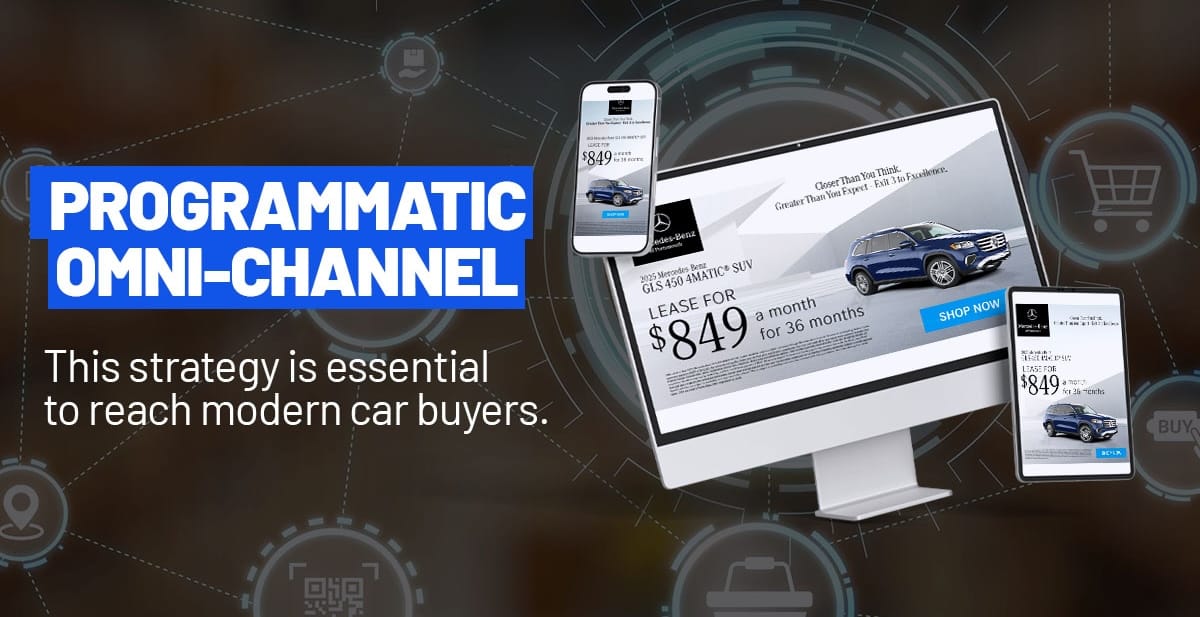
Today's car buyers don't stay in one lane. Their research spans search engines, social media, streaming TV, dealership websites, and third-party review sites — often jumping across multiple devices in a single evening.
If your advertising treats each of those channels as a separate, siloed effort, you're no longer competing effectively. Consumers move fluidly across devices and media, and advertising strategies have to do the same.
In 2026, automotive advertisers who consolidate their media buying into a unified omni-channel programmatic strategy are reaching more of the right buyers, generating stronger performance, and gaining measurable advantages across the full purchase funnel. Here's why an integrated approach is the only way forward for modern dealerships.
1. The Modern Car Buyer Is Everywhere — Literally
The automotive purchase journey has become one of the most complex in digital marketing. According to recent industry research, the average car buyer engages with 24 total touchpoints during their purchase journey, and 19 of those are digital. They spend over 14 hours researching online before making a decision, visiting an average of four separate car search sites along the way.
Cox Automotive's 2026 Car Buyer Journey Study found that 71% of vehicle buyers went into the process with an open mind about what they'd purchase, and 66% considered both new and used vehicles. That means the research window is long, fluid, and spread across every screen in the house.
No single channel captures your entire audience.
A shopper might start on Google, watch a CTV ad that night, scroll past your social ad the next morning, and land on your VDP page from a retargeting display ad that afternoon. An omni-channel programmatic approach ensures your dealership meets that buyer at every step of their journey. Not just one or two.
2. Multi-Channel Programmatic Delivers Measurable Performance Gains
Running campaigns across multiple channels through a single programmatic platform isn't just convenient — the performance data backs it up.
According to research conducted by StackAdapt in partnership with Advertiser Perceptions, advertisers who implemented a multi-channel strategy reported clear, measurable benefits:
Over half cited extended reach as a top benefit of multi-channel campaigns.
50% reported improved return on investment.
60% said their multi-channel campaigns meet or exceed KPIs most or all of the time.
These gains come from the compounding effect of cross-channel exposure. A consumer who sees your CTV spot, encounters a display ad during their morning research, and gets retargeted on social that afternoon is far more likely to recall your dealership than someone who only saw one of those impressions. Each touchpoint reinforces the last.
For automotive specifically, where purchase cycles run weeks and research is intensive, that sustained, cross-channel presence is what separates the dealerships shoppers remember from the ones they scroll past.
3. Full-Funnel Orchestration Requires Multiple Touchpoints
Vehicle purchases are high-consideration decisions. Different channels play distinct roles at different stages of the buyer journey, and an omni-channel strategy lets you orchestrate them intentionally rather than hoping isolated campaigns accidentally overlap.
Top of funnel (awareness): Connected TV and streaming video build broad awareness among in-market households. CTV delivers the scale and attention of traditional television with the targeting precision of digital — reaching specific demographics, geographies, and behavioral segments rather than a generic broadcast audience.
Mid-funnel (consideration): Display advertising, programmatic audio, and social placements sustain brand recall through repeated cross-screen exposure. The buyer who saw your CTV spot last night encounters your display ad this morning. That sequential reinforcement keeps your dealership top of mind during the longest stretch of the research process.
Bottom of funnel (conversion): Search engine marketing and retargeting close the sale. Buyers who've been primed by upper and mid-funnel messaging are more likely to click your search ad, visit your VDP pages, and submit a lead. Without the preceding touchpoints, bottom-funnel campaigns work harder for less return.
When these layers are coordinated through one platform, every dollar spent at one stage compounds the performance of the next. When they run in silos, you're paying more to accomplish less.
4. Consolidated Data and Attribution Are Now Essential
One of the biggest operational pain points in multi-channel advertising is understanding what's actually driving results. When campaigns live on separate platforms with separate dashboards, you lose visibility into how channels influence each other, and that creates real problems.
Disconnected channels lead to attribution gaps, reporting inconsistencies, and wasted spend on impressions that look productive in isolation but don't contribute to the overall outcome. For dealerships managing complex local and regional campaigns across multiple media types, this fragmentation makes it nearly impossible to optimize budget with any confidence.
Executing your strategy through a single programmatic platform solves this directly. Consolidated reporting means all channels — CTV, display, video, audio, digital out-of-home — are measured using the same methodology and technology.
That gives you consistent, comparable data, cleaner attribution, and the ability to shift budget toward the tactics generating actual business results rather than the ones producing the prettiest platform-specific report.
5. Dealers Who Are Shifting Budgets Now Are Gaining the Advantage
U.S. programmatic digital display spending surpassed $180 billion in 2025 and is projected to exceed $200 billion in 2026, accounting for the vast majority of all digital display ad spend. This isn't a niche tactic anymore — it's the infrastructure of modern advertising.
Within that landscape, the move toward omni-channel execution is accelerating. Research shows that 40 percent of advertisers plan to increase their programmatic spend in the next 12 months, driven by better ROI, improved targeting capabilities, and measurable performance benefits. Agencies and top-performing dealerships are increasingly managing campaigns across channels through demand-side platforms that enable cross-device targeting and unified optimization.
The competitive math is simple.
Dealerships running coordinated omni-channel strategies maintain visibility across the entire buyer journey, capture streaming audiences competitors miss, and drive measurable lift in branded search, site traffic, and lead volume. Dealerships still running isolated campaigns on individual platforms are paying more to reach less of their market.
Ready to unify your automotive advertising?
If your campaigns are running in silos across disconnected platforms, you may be losing reach, wasting budget, and missing the full picture of what's driving results.
Get a custom omni-channel programmatic strategy built around your market, inventory, and buyer journey with Click Here Digital.

Contact us today and watch your business grow.
Ready to take your marketing strategy to a new level?
We'd love to hear from you.