
The New Rules of Data: Outdated SEO Metrics to Stop Obsessing Over
July 22nd 2026 by Click Here Digital
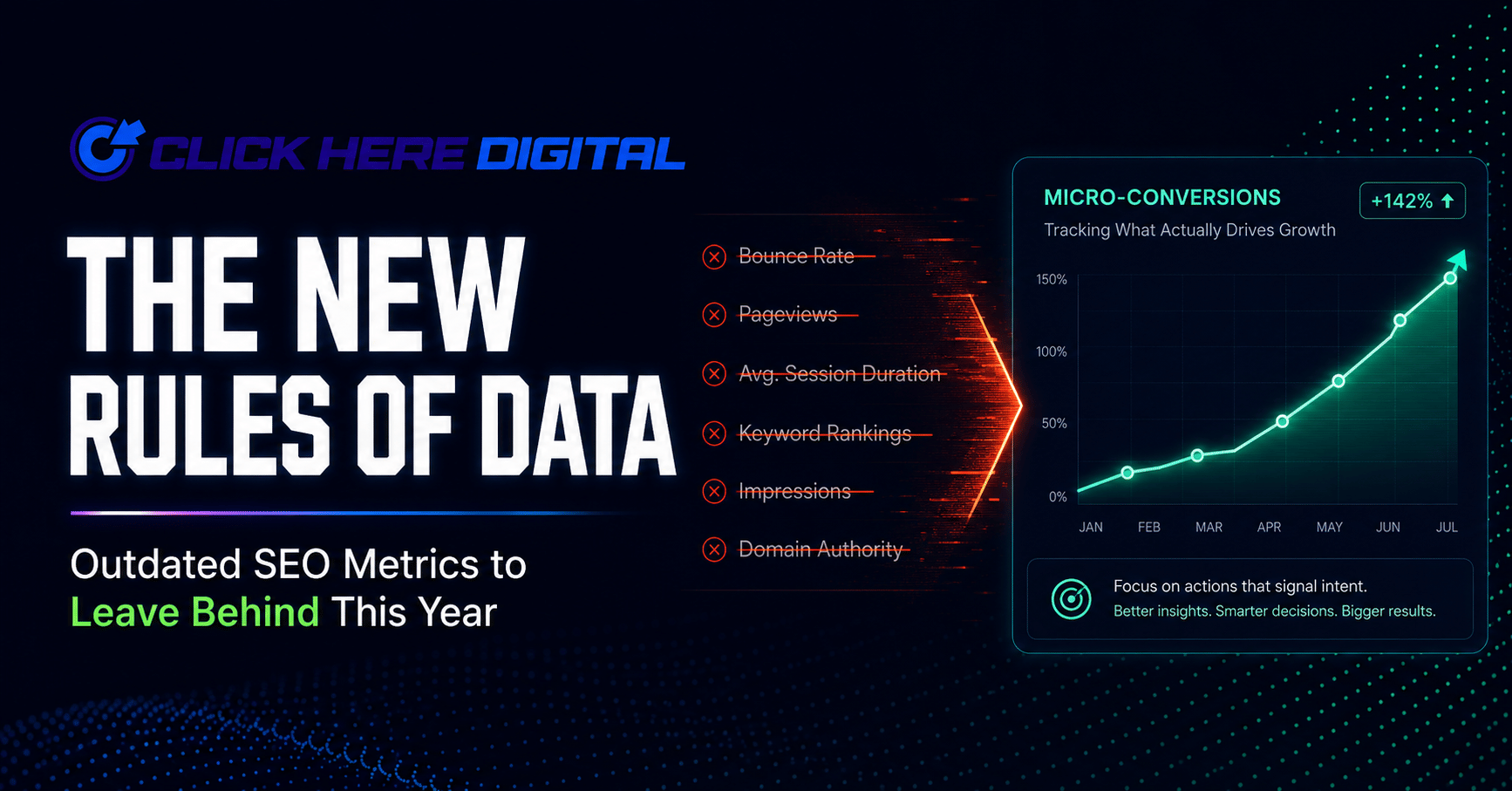
The metrics we used to judge organic search success just don’t give you the whole picture anymore. Thanks to the boom of conversational search, AI-driven answers, and hyper-local algorithms, the traditional SEO dashboard is facing a massive structural shift.
If your marketing agency is still sending over monthly reports centered entirely around raw volume, isolated rankings, and empty vanity metrics, they are optimizing for an older version of search that no longer exists.
To build a truly future-proof strategy, we look past surface-level numbers and focus on what drives actual business growth. Let’s break down the old metrics that aren’t nearly as relevant anymore, and the modern alternatives you should track instead.
Topic 1: Keyword Rankings
The Old Metric: Tracking whether your website ranks #1 for an isolated, high-volume industry keyword.
Why It's Not Relevant Anymore: Holding the absolute top organic spot simply doesn't guarantee a massive flood of clicks like it used to. Between rich snippets, local map packs, and AI Overviews physically pushing standard results down the screen, that top real estate is completely decentralized. Plus, tracking single keywords is wildly inaccurate because modern search is incredibly volatile and personalized; the search results look totally different for everyone depending on their location, device, and personal history.
The Better Metric to Study: Related Keyword Group Performance. Instead of hyper-focusing on a single word, track your overall visibility across clusters of related search terms. This gives you an honest look at your topical authority and true market share.
Topic 2: Traffic & Visibility Volume
The Old Metrics: Raw clicks and total impressions.
Why They're Not Relevant Anymore: A sudden spike in organic clicks or impressions looks great on a chart, but it's easily inflated by broad, top-of-funnel informational queries. If thousands of users are viewing an informational blog post but none of them are in your target market or ready to buy, those numbers are just empty vanity data.
The Better Metric to Study: Branded vs. Non-Branded Revenue Traffic. You need to separate users who already know your name from high-intent local users searching for what you sell (e.g., separating "Findlay Honda" searches from "SUVs for sale near me"). Tracking non-branded traffic growth in your primary market area measures true business acquisition.
Topic 3: User Engagement
The Old Metrics: Bounce rate and average session duration (time on page).
Why They're Not Relevant Anymore: Modern user behavior is fast and direct. If a consumer lands on a highly optimized landing page, immediately finds your phone number or store hours, calls you, and exits the browser, traditional metrics label that session a "bounce." The user was perfectly satisfied, but the old data flags it as a failure. Conversely, a long time on a page might just mean a user is confused by a cluttered layout.
The Better Metric to Study: GA4 Engagement Rate & Micro-Conversions. Look at active interaction metrics. Did the user scroll down? Did they click your phone number, submit an intake form, or launch map directions? True user engagement is measured by active intent, not passive clock-watching.
Topic 4: Backlinks
The Old Metric: Accumulating a massive quantity of traditional backlinks from random websites just to inflate your domain authority score.
Why It's Not Relevant Anymore: Search algorithms have become highly sophisticated at identifying and devaluing manipulative, automated, or irrelevant link schemes. A thousand low-quality links from generic, disconnected directories carry virtually zero weight today and can actively harm your site's trust signals.
The Better Metric to Study: Digital Brand Authority and Local Citations. Modern search engines prioritize topical relevance over raw numbers. Attaining a much smaller number of highly relevant, trusted local directory listings, verified industry platforms, and community mentions does infinitely more to prove your real-world authority to an algorithm than a massive, untargeted link profile.
The Bottom Line: Organic search is no longer about trying to trick a system with empty volume or rigid, outdated tracking sheets. It is about creating clean, deeply integrated digital experiences that connect high-intent shoppers with your business no matter where or how they choose to search.
Want to look at your actual organic engagement data?

Contact us today and watch your business grow.
Ready to take your marketing strategy to a new level?
We'd love to hear from you.